Originally posted on September 8, 2006 @ 7:23 am
Google turns eight today. Happy Birthday! But so far no spiffy Google Birthday logo :(
Originally posted on September 8, 2006 @ 7:23 am
Google turns eight today. Happy Birthday! But so far no spiffy Google Birthday logo :(
Originally posted on September 2, 2006 @ 2:17 pm
I’m always in search of new technology and when I find something interesting, I like to share it, especially when it has to do with music.
I’d like to introduce you to BlogMusik.net – Free Internet virtual iPod for Music Albums playlist Beta.
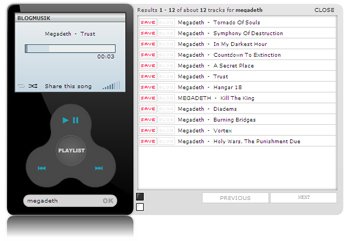
How does it work you ask? Well you type in the song title or artist you’d like to hear into the search box and it brings up a side menu as you can see in my screen shot above with all the songs it has available that fits your search.
You then click the song title and bam! It starts to play right on your computer. If you register, you get even more options. Check it out for more information.
On the technical side of things this cool web application at first glance I thought was using AJAX for the controls but after more looking I realised it’s using a lot of Flash to handle all the on screen controls and from what I can tell from messing with it for about an hour, it’s also using PHP with a MySQL database backend, so it runs really fast.
So far on the song availability front, every song title or group that I’ve searched for on BlogMusik, it’s had at least a few songs to choose from. The sound quality is pretty decent too.
Originally posted on July 30, 2006 @ 1:32 pm
Just a quick note for the people who come to download MAME from my site you can now download the latest version of MAME32 version 0.107 from my MAME page.
I’m expecting updated versions of MacMAME (Macintosh) and XMAME (Unix) soon, so keep checking my MAME information section for updates.
If MAME isn’t your game emulator of choice, be sure to check my other emulators page for some great links.
Originally posted on September 27, 2006 @ 9:04 am

Originally posted on August 3, 2006 @ 9:17 am
Yes, it’s true. Google is kicking some major butt for being the search engine of choice. Granted, Google’s stock price may have declined in recent weeks but its share of the U.S. search market continues to rise. Yay Google!
During the four-week period ending July 29, 60.2% of U.S. based Internet searches were executed at Google, according to Internet metrics company Hitwise. This is up from 59.3% in June.
In the same period, Yahoo Search also gained market share, moving from 22.0% to 22.5%. MSN Search saw a slight decrease, falling from 12.1% to 11.8%.
These top three search engines accounted for over 94% of all searches in the United States. Other search engines together accounted for just 5.5% of U.S. searches.
Moral of the story? Google rocks. Now if we can just get more people using Firefox instead of Internet Exploder.